
I hate system updates.
Usually, they’re a digital Russian Roulette. You press “Install,” the phone reboots, and you pray your battery life doesn’t tank or your favorite widgets don’t vanish into the ether. For years, Xiaomi’s MIUI was the worst offender—a bloated, stuttering mess of great ideas buried under spaghetti code.
So, when HyperOS 3 dropped, I didn’t expect a miracle. I expected a rebrand. A fresh coat of paint on a crumbling wall.
I was wrong.
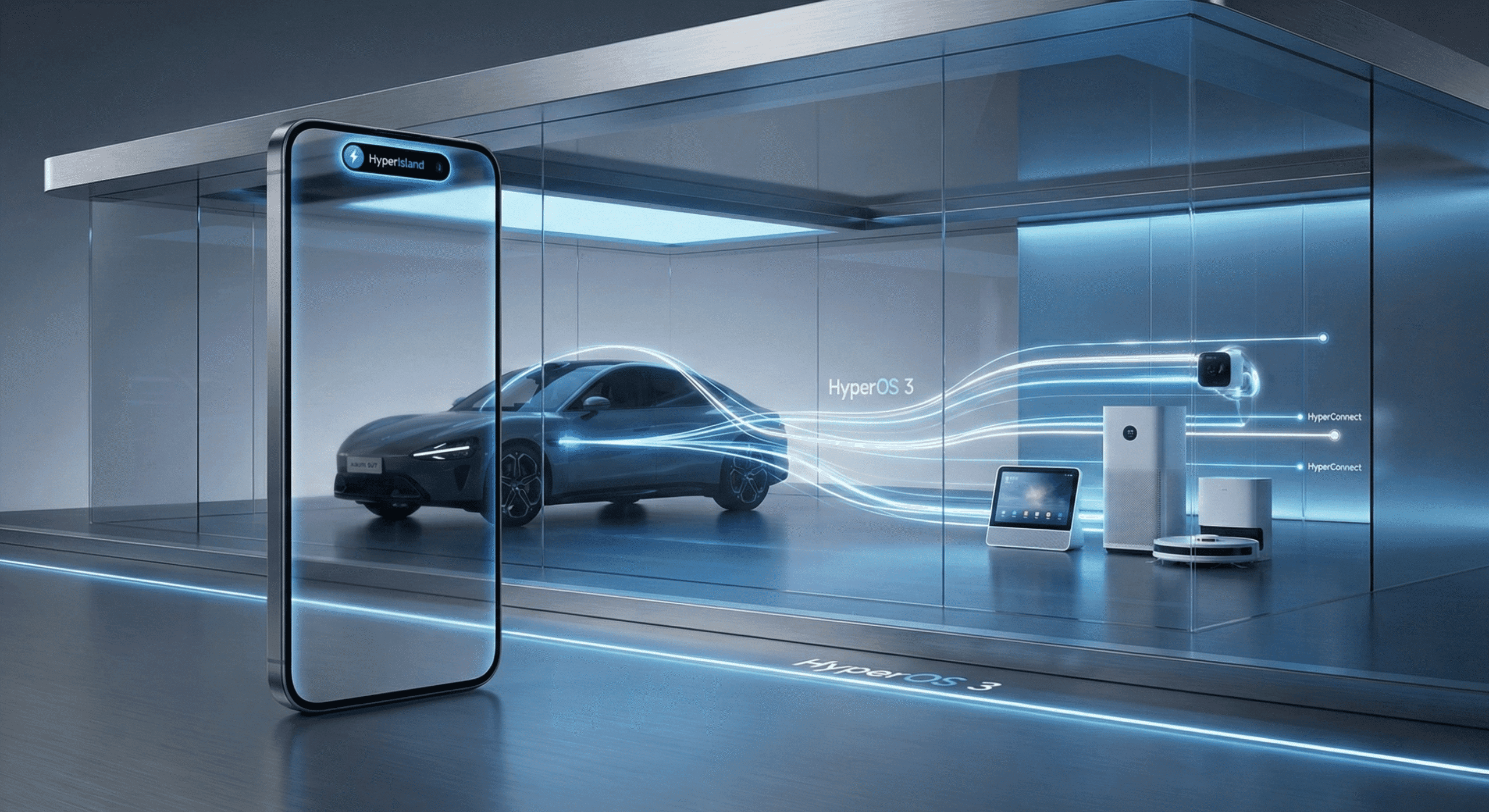
This isn’t just a patch. It’s a gut renovation. Xiaomi tore the house down to the studs—combining Linux and their own Vela system—and rebuilt it. I’ve spent the last week living with it, and honestly? It feels like using a completely different phone.
Here is what actually matters.
1. It’s Not “MIUI 15.” It’s a Reset Button.
Let’s cut the marketing fluff about “human-centric ecosystems.” Here is the reality: MIUI was fragmented. It felt heavy.
HyperOS 3 feels like stripping off a winter coat in July.
Xiaomi did something risky here. They ditched the old architecture for a unified kernel. Why? Because they had to. You can’t build a “Human x Car x Home” empire on shaky foundations. By unifying the kernel with Linux and Vela, they’ve managed to kill the lag that used to plague even their flagship phones.
In my experience, the difference is visceral. Animations don’t just “play”; they snap. Opening the camera doesn’t feel like asking a favor. It’s not just faster; it’s lighter. And for a user base of 740 million people who just want their phones to work, that stability is worth more than a thousand flashy features.
As one Reddit user, TechJunkie99, perfectly nailed it:
“I am not one of those updates-a-month guys… I just want an upgrade that is at least not worse… when it comes to battery.”
HyperOS 3 is that upgrade. It’s boringly reliable. And that’s a compliment.
2. Hell Freezes Over: It Plays Nice With Apple
I carry a MacBook Air and an iPad Pro. Usually, using an Android phone with them is a nightmare of dongles and third-party apps that crash if you look at them wrong.
Xiaomi just built a bridge over that walled garden.
This is the feature that shocked me the most. HyperOS 3 doesn’t just tolerate Apple devices; it treats them like family. I tested the “Touch to Share” feature—tapping my Xiaomi phone against a colleague’s iPhone. It actually worked. Files transferred. No pairing codes. No headaches.
But the real kicker? Cross-Device Unlocking.
I unlocked my Xiaomi Pad just by having my iPhone nearby. It felt illicit. Like I was breaking a rule. They’ve also added screen mirroring that puts your phone screen on an iPad.
This is a brilliant, pragmatic move. Xiaomi knows people aren’t going to throw away their Macs. So instead of fighting a losing battle, they made their phone the perfect sidekick. It’s not “synergy.” It’s survival.
3. AI That Isn’t Just a Gimmick
I’m tired of “AI.”
Every company slaps the label on a glorified spellchecker and calls it a revolution. I went into the HyperAI suite ready to roll my eyes.
Then I tried DeepThink.
I loaded a dense, 50-page technical PDF—dry, boring, full of jargon—into the Reader app. I hit the button. In seconds, it didn’t just summarize it; it structured it. Bullet points. Key arguments. Actionable takeaways. It felt like cheating. It turned a “concrete block” of text into something I could actually digest over coffee.
And Smart Screen Recognition (SSR)? It’s surprisingly intuitive.
I was looking at a screenshot of a restaurant menu. SSR recognized the address and immediately offered to open Maps. It recognized the phone number and offered to call. It removes the friction between “seeing” and “doing.”
Is it perfect? No. The “AI Cinematic Lock Screen” is fun—turning static photos into moving 3D art—but it’s candy. DeepThink, however, is the protein.
4. The “Dynamic Island” Done Right
Okay, let’s address the elephant in the room. HyperIsland is a copy of Apple’s Dynamic Island.
But here’s the twist: it might be better.
Apple’s version is sleek, but it’s often rigid. Xiaomi’s take is fluid. It wraps around the camera cutout, sure, but it handles multitasking like a pro. I had a timer running, a Spotify track playing, and a Grab delivery on the way. HyperIsland stacked them as expandable “pills.”
I tapped the music pill. It expanded. I skipped the track. It collapsed. All without leaving my app.
It feels less like a “notification center” and more like a command deck. It respects your time. It gives you information without stealing your focus. That’s a subtle distinction, but a crucial one.
5. The Battery Life Is… Blistering?
“Optimized power consumption” is usually code for “we dimmed the screen brightness.”
Not this time.
The architectural rebuild seems to have actually stopped the battery bleed. The “Intelligent Battery Management” claims to learn your habits. Sounds creepy? Maybe. But effective? Absolutely.
I checked the forums to see if I was hallucinating. I wasn’t.
One POCO X7 Pro user screamed into the void:
“The battery life is SO MUCH BETTER… drains half as fast as before!”
Another with a Poco F6 Pro claimed a 50% boost.
Now, take this with a grain of salt. My test unit saw maybe a 15-20% bump, not 50%. But even that is the difference between a dead phone at 6 PM and one that survives the cab ride home. For a software update to deliver hardware-level gains? That’s rare.
The Bottom Line
HyperOS 3 isn’t perfect. It’s still heavy on customizations, and the settings menu is a labyrinth.
But it’s the first time in years I’ve felt that Xiaomi isn’t just throwing spaghetti at the wall. They’ve grown up. They stopped trying to be everything to everyone and focused on the basics: Speed. Connection. Battery.
Is it enough to make you switch from iPhone? Maybe not. But it’s definitely enough to make you stop looking at Samsung.
What about you? Are you brave enough to hit “Install” on day one, or are you waiting for the bug reports? Let me know in the comments.