
Stop me if you’ve heard this one before. To win, you must suffer. You need to wake up at 4:00 AM, drink raw eggs, and hit forehands until your calluses have calluses. We treat elite performance like a math problem where Effort + Time = Glory.
It’s a nice story. It sells sneakers. But it’s mostly garbage.
If you actually look at the data—and if you’ve spent as many years as I have watching hopefuls flame out on the Challenger tour—you realize the path to the top is weird. It’s messy. It’s counter-intuitive. A recent deep-dive into serve biomechanics and the strange, resurrection-like season of Botic van de Zandschulp just blew the lid off the standard playbook.
Here is what is actually happening out there.
1. The “Power vs. Precision” Myth is Dead
In baseball, if you swing for the fences, you strike out more. In golf, a long drive usually ends up in the rough. For decades, tennis coaches have preached this gospel: Slow down the serve to get it in. They treated velocity and accuracy like a zero-sum game.
They were wrong.
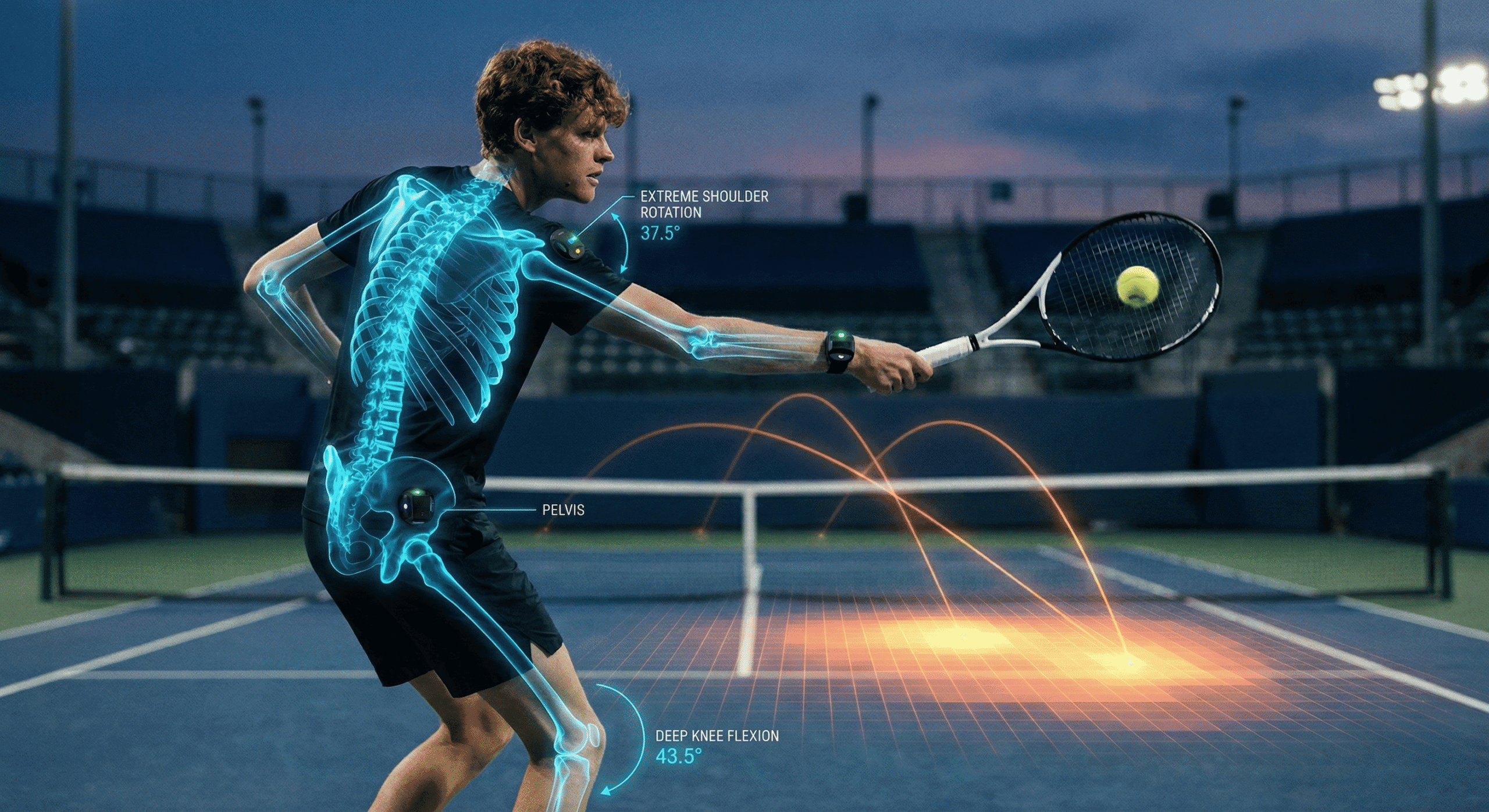
A study recently published in the Journal of Physical Education and Sport took a wrecking ball to that assumption. They took a squad of high-level players and put them through a six-week, biomechanics-focused wringer. They didn’t just tell them to “hit it harder.” They rewired their kinetic chains.
The numbers were startling. Speed went up by 4.2 km/h. Accuracy? That climbed by 4.1%.
Think about that. They swung harder and hit the target more often. How? Efficiency. When you clean up the mechanics—removing the energy leaks in the shoulder rotation or the knee bend—the ball goes where you want it to go, faster, with less effort. It’s not a trade-off. It’s a synergy. (Okay, I hate that corporate word, but here it actually fits). You can have your cake and smash it, too.
2. Sometimes, You Need to Quit to Win
If the lab coat guys proved we need better mechanics, Botic van de Zandschulp proved we need to stop trying so damn hard.
The Dutchman’s 2024 season was a dumpster fire. He fell out of the top 100. He was losing to guys you’ve never heard of. After the French Open, he admitted he was thinking about hanging up the racquet. He didn’t double down. He didn’t hire a “mindset guru.”
He went home.
For two weeks, he didn’t touch a racquet. He sat on his couch. He thought about life. He stepped off the hamster wheel because the wheel was spinning him into the ground.
And then? Magic.
He walked into the US Open and dismantled Carlos Alcaraz. Straight sets. He beat the world number 3 like he was stealing lunch money. This wasn’t because he practiced an extra hour. It was because he stopped practicing. In a sport obsessed with repetition, the biggest weapon might just be a two-week vacation.
3. The “IDGAF” Superpower
I love passion in sports. But let’s be honest: the screaming, the fist-pumping, the shirt-tearing? It’s often just anxiety masquerading as intensity.
During that Alcaraz match, van de Zandschulp looked like he was waiting at the DMV. Stone cold. Reddit went wild, joking that he looked annoyed that winning meant he had to cancel his flight home.
But that “boredom” was lethal.
In my experience, pressure feeds on emotion. If you care too much, your arm gets heavy. Your feet get stuck in the clay. By detaching himself from the outcome—by adopting a genuine “I Don’t Give A…” attitude—Botic inoculated himself against the moment. He played freely because he had already accepted the worst-case scenario.
Stoicism isn’t just philosophy. On a break point in the fifth set, it’s a tactical nuke.
4. The “Old Dog” Fallacy
There is this pervasive rot in the industry that says if you haven’t broken through by 22, you’re cooked. At 30? You’re basically a dinosaur waiting for the asteroid.
The biomechanics study I mentioned earlier? It specifically targeted athletes who “typically show limited potential for further gains.” Veterans. And yet, they improved. Drastically.
Botic is 30. He’s arguably playing the best tennis of his life. He pointed to Adrian Mannarino, a guy who hit his career peak at 36, playing with a style that looks like he’s swatting flies at a picnic. The biological ceiling is flexible. We assume skills ossify with age, but that’s just a lack of imagination. If you stay curious, and if you keep refining the machine, the window stays open a hell of a lot longer than the pundits admit.
5. The Margins Are Razor Thin
Here is the scary part. The difference between the guy holding the trophy and the guy flying home economy class is microscopic.
Botic was ranked #74 when he beat Alcaraz (#3). A month before that, he lost to a guy ranked #577.
Does that make sense? No. But that’s tennis. The talent pool is absurdly deep. I’ve watched qualifiers on the back courts of nowhere tournaments hit balls with the same pace and spin as Novak Djokovic. The raw ability is everywhere.
The gap isn’t the forehand. It’s the belief. It’s the sleep you got the night before. It’s whether or not your girlfriend broke up with you via text in the locker room. On any given Tuesday, the #500 guy can beat the #5 guy if the stars align. The hierarchy is an illusion.
The Bottom Line
So, what have we learned?
The best way to hit faster is to stop trying to muscle it. The best way to care is to stop caring. And the best way to move forward might be to stop moving entirely.
The grind is overrated. Go take a nap. You might just wake up a champion.