
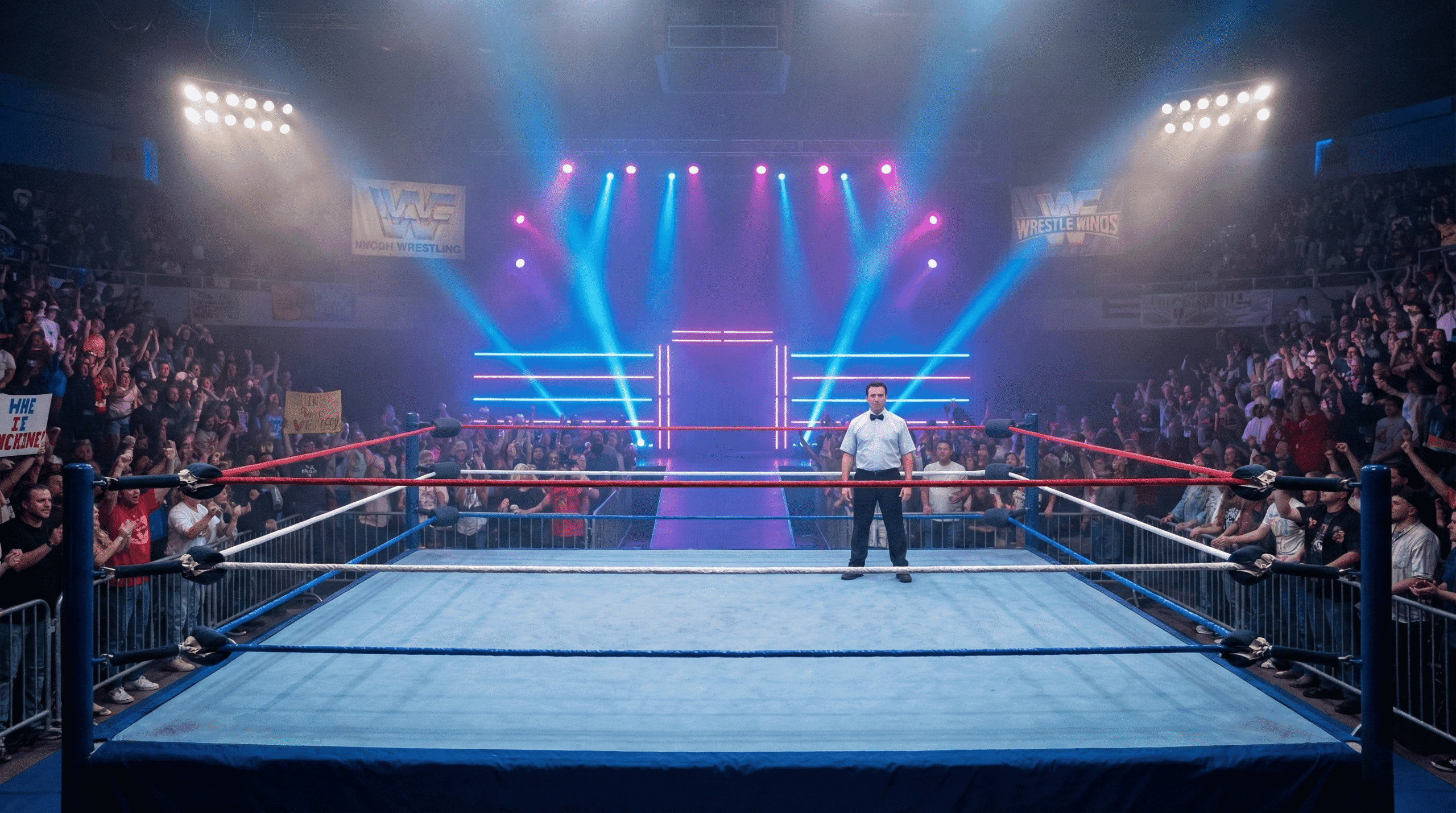
1.0 Introduction: The Night the World Stopped
You think you know the story. Big muscles, bad acting, good conquering evil. But if you peel back the curtain on WWE’s Saturday Night’s Main Event (SNME), you don’t find a simple variety show. You find a funhouse mirror reflecting American culture right back at us.
I’ve spent years analyzing pop culture trends, and frankly, nothing confuses me—or impresses me—quite like the legacy of SNME. It’s a beast. A strange, contradictory beast that explains more about our fragmented media diet than a thousand think pieces ever could.
2.0 The Ratings Monolith
33 million people.
Let that number sit for a second. In 1988, a wrestling match between Hulk Hogan and André the Giant pulled in a viewership that would make modern Super Bowl advertisers weep. Today, getting a million eyes on a screen feels like dragging a concrete block uphill. Back then? It was effortless.
The show wasn’t just “popular.” It was the oxygen in the room.
Debuting in 1985 to replace SNL reruns, this wasn’t some niche curiosity for insomniacs. It was a juggernaut. NBC didn’t just air it; they rode it. That 15.2 rating in ’88? It’s still the high-water mark for wrestling on television. Period. It reminds us of a time when we all drank from the same water cooler. We didn’t have algorithms feeding us personalized content bubbles. We had Hogan. And we loved it.
3.0 Killing the Hero
I’ll be honest: watching John Cena tap out hurt.
When the “Face that Runs the Place” stepped into the ring for his final match at the December 2025 SNME, the script seemed written in stone. Triumphant exit. Tears. Fade to black. Instead, we got a gut punch. Gunther didn’t just beat him; he broke the “Never Give Up” ethos in half.
The arena didn’t just boo. They revolted.
“You f***ed up.” That was the chant hurled at Triple H. It wasn’t heat; it was hatred. In my experience, wrestling fans can handle a loss, but they can’t handle a betrayal of logic. Yet, that’s exactly what this was. A cold, calculated move to cash in a legend’s equity to mint a new monster. It was business disguised as tragedy. And it left the locker room—and the fanbase—split right down the middle.
4.0 The Montreal Paradox
Here’s where it gets messy.
On paper, Sami Zayn winning in his hometown of Montreal on January 24, 2026, was the layup of the century. Easy pop. Happy ending. But if you logged onto Reddit that night, you didn’t see a victory lap. You saw a civil war.
One camp was crying tears of joy, calling it “perfect.” The other? They were venomous.
“Sami? Gross. Looks like a rando at the local bar,” one user spat. Another claimed the predictability made them physically ill. It was jarring to watch. How can one moment be a masterpiece to half the audience and an insult to the other?
“When did Reddit turn against Sami????” one confused fan asked.
That’s the question, isn’t it? It highlights the impossible tightrope modern storytelling walks. We want surprise, but we hate shock. We want logic, but we hate predictability. You can’t win.
5.0 When Kayfabe Meets Geopolitics
This is the part that genuinely blew my mind.
Wrestling is scripted. Geopolitics is not. But somehow, SNME managed to crash these two worlds together in the weirdest way possible. During a broadcast, a commentator mentioned Sami Zayn—a wrestler of Syrian descent—would “carry the country of Saudi Arabia on his shoulders.”
The internet paused. What?
“Wild,” one fan posted. “Gross,” said another. But then, the theories started flying. Real, complex socio-political theories. One user posited that Zayn was a proxy for representation in a region starved for it. Another went deeper, analyzing the color palette of his gear, linking it to the Palestinian and Syrian flags.
“How else do you think he got it past WWE?” they speculated.
Think about that. Fans weren’t talking about headlocks. They were decoding international relations through spandex. It proves that the audience isn’t just watching a fight; they’re scanning for identity, for politics, for meaning in places the writers probably never intended.
6.0 The Final Bell
So, is Saturday Night’s Main Event just a wrestling show? Hardly.
It’s a cultural artifact. A litmus test for how we consume media, how we treat our heroes, and how we project our own identities onto characters fighting in their underwear. It’s messy. It’s loud. And sometimes, it makes absolutely no sense.
But that’s why we watch, isn’t it?