
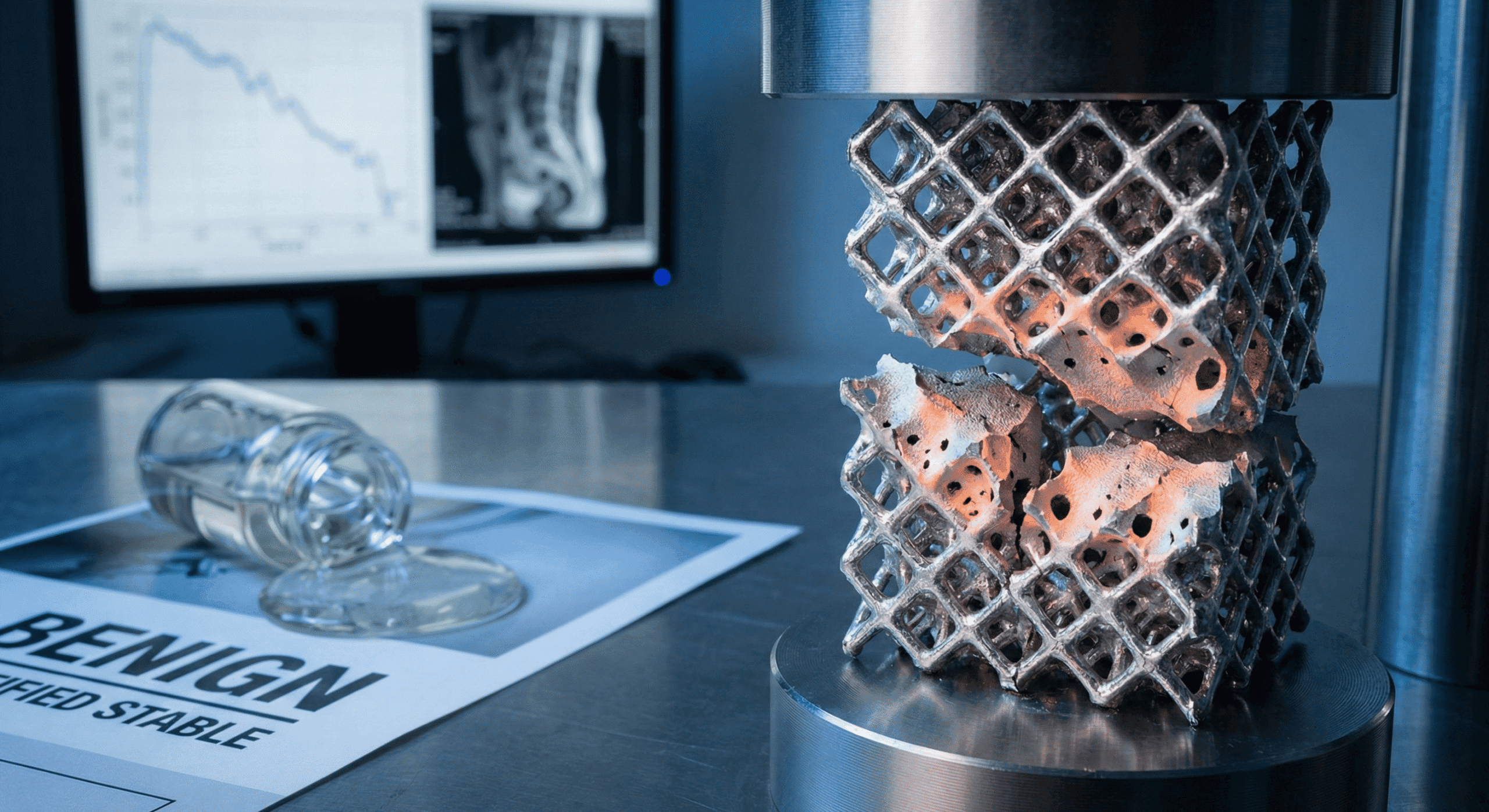
You usually find out something is unstable the moment it fails. That’s the irony of engineering, isn’t it? We build, we assume, and then—snap. Whether I’m looking at a 3D-printed bracket snapping under a load it was “rated” for, or a dental implant that refuses to integrate, the lesson is always the same: Static assumptions get you killed. Or at least sued.
We have to stop guessing. We have to stop trusting the label on the bottle.
Real stability isn’t a fixed state; it’s a volatile relationship between a material’s molecular signature and the messy, chaotic environment you put it in. In my experience, relying on the “industry standard” is often the fastest way to mediocrity. Here are three cases where the conventional wisdom is wrong, and the data tells a much darker story.
1. The “Palatal” Advantage (Or, Why Chemistry Beats Geometry)
I’ve placed enough implants to know the sinking feeling of a “spinner”—an implant that just won’t lock in. The biological success of these things comes down to a race. It’s a race between mechanical stability (how tight you screwed it in) and biological stability (how fast the bone grabs the metal).
If you lose that race, the implant fails. Simple as that.
Conventional wisdom says you just need a rough surface (SLA). But the data suggests we’ve been missing a trick with surface energy.
Look at the “SLActive” surface. It’s not just sandblasted; it’s manufactured under nitrogen and stored in saline. It never touches air. Why does that matter? Because titanium oxides instantly when it hits oxygen, reducing its reactivity. By keeping it “fresh,” the surface stays hydrophilic. It literally pulls blood into its micropores.
The result?
In the palatal region—notoriously difficult real estate for orthodontic anchorage—the healing window drops from five weeks to four. That one week is the difference between a patient waiting in limbo and starting their treatment.
So, don’t just look at the shape of the screw. Look at the chemistry. If you’re working in poor bone quality, that hydrophilic surface isn’t a luxury. It’s a lifeline.
2. The 3D Printing “Datasheet” Scam
Let’s be honest: Manufacturer datasheets are often marketing fiction.
I recently ran dynamic tests on some high-end resins, and the gap between what the brochure promised and what the physics delivered was insulting. We’re talking about Young’s modulus—stiffness. The stuff that keeps a bridge from wobbling.
You can’t just trust the static numbers. You have to ring the material like a bell. We used flexural vibration tests (Euler-Bernoulli theory, for the nerds in the back) to find the actual stiffness.
The findings were brutal.
- The Winner: “Liqcreate Composite-X.” This stuff is a tank. A Young’s modulus of $0.93 \times 10^{10}$ Pa. It rings at 318 Hz. It’s rigid, reliable, and acts like a true ceramic composite.
- The Loser: “Phrozen Water-Washable Resin.” Everyone loves this stuff because you can wash it in the sink. It’s convenient. But convenience has a cost. It clocked in at a distinctively floppy $0.30 \times 10^{10}$ Pa.
That’s a massive delta.
If you print a structural part with the “eco-friendly” washable resin because the box said it was “durable,” you are designing for failure. The ease of processing (washing with water) is a direct trade-off for mechanical integrity. Don’t fall for the fluff. Test your own beams.
3. When “Benign” is a Ticking Time Bomb
“It’s benign.”
Doctors love saying this. It calms the patient. It lowers the blood pressure. But in the case of Hepatocellular Adenoma (HCA), that word is a lie.
These liver tumors are rare, sure. But if you’re a long-term user of oral contraceptives (OCs), your risk shoots up from 1 in a million to 40 in a million. And unlike most benign lumps that just sit there, these can rupture. Spontaneously.
I’ve seen the data on the mortality rate for rupture—it’s between 5% and 10%. That is not “benign.” That is Russian Roulette.
The danger isn’t uniform, though. It’s molecular. We used to just look at the size, but now we have to look at the genes.
- The Inflammatory Subtype: Often found in patients with high BMI. It looks like a peliosis—dilated, bloody sinusoids—under the scope.
- The Beta-Catenin Mutation: This is the nightmare scenario. It carries a massive risk of turning into full-blown liver cancer.
Here is the takeaway: You cannot manage what you cannot see. We need to use hepatospecific MRI contrast agents (like Gd-BOPTA) to distinguish the safe(ish) tumors from the killers. If a patient has that beta-catenin marker, or a tumor larger than 5cm?
Cut it out. Don’t watch and wait.
The Verdict
Stability is a moving target.
Whether it’s the microscopic hydrophilicity of a titanium screw or the hidden genetic mutation in a liver cell, the details we ignore are the ones that bite us. We are moving past the era of “one-size-fits-all” engineering.
So, stop trusting the summary. Dig into the raw data. Test the materials yourself. Because when the load is applied, the universe doesn’t care about your assumptions. It only cares about the physics.